Český Krumlov (UNESCO castle and historical city, 23 km)
Český Krumlov, the pearl of South-Bohemia, was placed on the list of the world’s most important monuments by UNESCO in 1992. Strolling along the streets of Český Krumlov is an experience on its own, but there are also several sights:

• The Castle, Zámek 59. Open daily from April until October, except Mondays (these opening hours apply for almost all castles in the Czech Republic).
• Also the Castle's park is worth of visiting and here you can watch a theatre play from a rotating tribune, a splendid spectacle. Daily shows in July and August, except Sundays.
• The international arts and culture centre Egon Schiele at Široká street 70 - 72 with its original artworks and documentation about the painter also provides season exhibitions with works of famous painters and sculptors.
• In the Regional Museum, a ceramic model of the city can be found, as well as an exhibition with the title "A historic view of the region Český Krumlov from the beginning of time until the 19th century“.
• The Gothic Vitus church originating from the early 15th century.
• Brewery Eggenberg at Latrán 27 is open for visitors all year. Tours with degustation on request.
• The graphite mine is possible to visit in July and August daily from 9 a.m. till 5 p.m. In June and September during the weekends. Address: Chvalšinská street.
• Finally: in the second half of June, the traditional feast of the Five Leaved Rose is held. It seems you are back in the middle ages with people dressed in ancient costumes, a fair, renaissance plays, living chess and at night the many midsummer parties.
Rafting on the river Vltava
You can enjoy a nice trip on a boat from Vyšší Brod to Český Krumlov or Zlatá Koruna or also further.

Boatcruises on the Lipno lake
At Lipno nad Vltavou (8 km) a roundtrip over the lake by covered boat is available. During peak season, it is also possible to embark in Frymburk, boat trip takes 1 hour 30 minutes, you can have refreshment there and see almost the whole Lipno lake.

Vyšší Brod (abbey)
Just outside the town, you will find the Gothic Cistercian monastery dating from 1259 with its unique library of 70 000 books and a postal museum. The monastery was damaged several times by fire. The church's present furnishing was restored during the forties of the 17th century in a mainly Baroque style. Also the abbey, which now serves as a postal museum, dates from this period, as well as most of the farm buildings next to the monastery. The monastery's library was founded in 1757 and contains rare manuscripts and is certainly worth visiting.
On the opposite side of the road, you find the river Moldew. Here you can rent a canoe for a short or long downstream trip to Český Krumlov and further, passing Vyšší Brod and castle Rožmberk. It is a real experience and not expensive at all.

Castle Hluboká nad Vltavou (10 km from České Budějovice)
Castle Hluboká has much resemblance to the English Windsor Castle. It was built in the last century, when the old castle was demolished. The castle holds 144 rooms and halls, loaded with art. You will find religious art from the period 1450 till 1530.
Castle Hluboká is surrounded by a beautiful park, worth a visit. There is also the zoo ZOO Ohrada. This is 2 km away from the castle.
České Budějovice (50 km)
It is a beautiful city with plenty guarded parking places (watch the "P" signs).
In the centre of the city you can find a square with sides of 133 m. The square is dominated by the city hall which was rebuilt between 1727 and 1730. At the roof you can see the statues "Justice" "Wisdom" "Courage" and "Providence".
The Samson fountain, which has been build between 1721 and 1727, is located in the middle of the square and along the sides of the square you will find little shops with lots of Bohemian crystal, gold and silver and lots of cosy terraces.

Kleť near České Budějovice
The highest mountain (1084 m) lays in the nature reserve the Blanský forest. There are hiking paths, marked with signs. From Krasetín at village Holubov a cable car leads to the top of the mountain. At the top, you can find a mountain shelter with a restaurant and the oldest stone watchtower at the Bohemia, dating from 1825. At a clear day, the Alps can be seen from here. Also the highest observatory of the Bohemia can be visited.
Zlatá Koruna
is a small village at the river Moldau. Its Cistercians monastery was founded by King Přemysl Otakar II. in the year 1263 and was annihilated in 1785. It is possible to visit the monastery. The visitor’s route takes you through the oldest part of the monastery, the chapel of the Protecting Angels. There is also an exposition on South Bohemian literature to visit.


Way of the crosses
A short, steep walk of about 2 km. This Way of crosses from 1894 to hill Marta was renovated in the years 1999 and 2000. Along the route you will find 14 crosses and at the top the renovated chapel "The High Torment". This trip provides a splendid view over Lake Lipno. At the different crosses, there are benches to have a rest and take pictures.


Frymburk
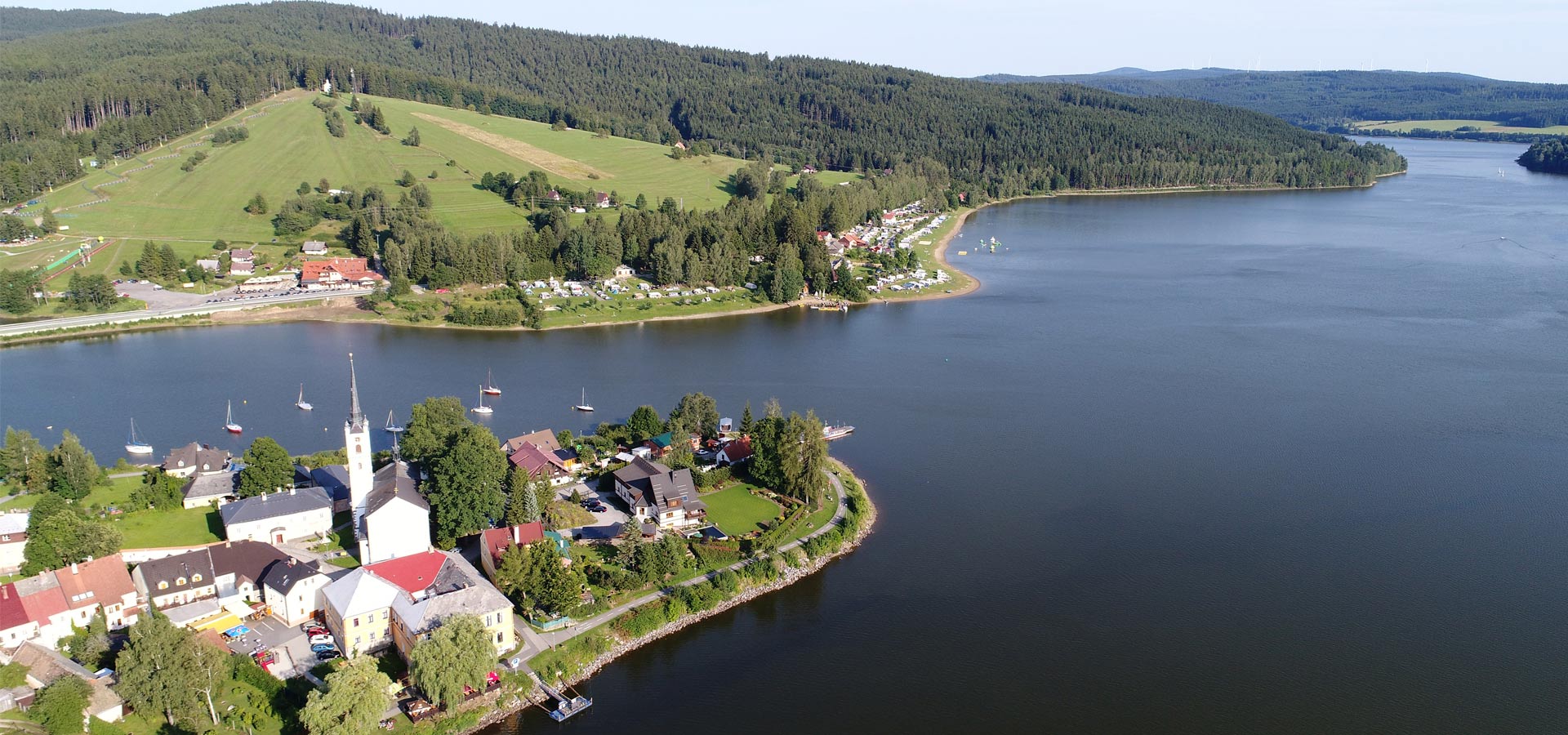
This picturesque South Bohemian town of Frymburk spreads at the foothills of Šumava at the altitude of 730 above the sea level. It is a unique town thanks to its exquisite location extending on the peninsula situated on the left bank of Lipno Reservoir which means that the town is largely surrounded by the waters of the „Šumava Sea“ and at the same time is located in the proximity of the Austrian borders. You can pass the state border through the border crossing Guglwald/ Přední Výtoň 10 km far from Frymburk. This town was originally founded as a merchant village at the end of the 13th century and was situated on the trading path leading from Upper Austria to Český Krumlov. However pre-historical findings prove that the location was settled from 8 to 10 thousand years B.C. The status of town was attributed to Frymburk in 1379 and the town brewery was established in 16th century.

Svatý Tomáš and ruins of castle Vítkův Kámen (16 km)
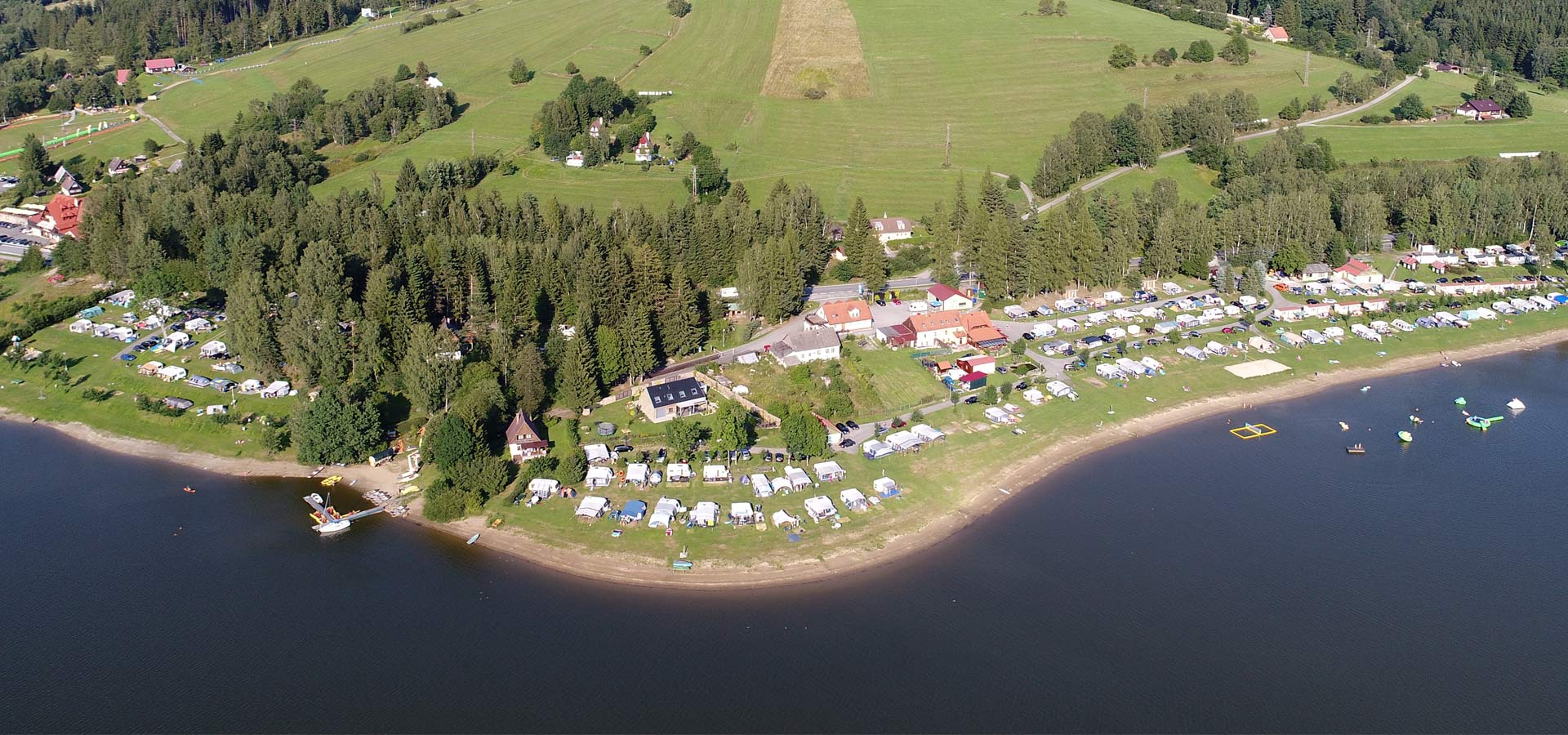
On the opposite shore from the camping, several walking and bike routes are indicated, e.g. the route to Svatý Tomáš village. This one is very beautiful, but rather steep. Only take this trip if you are trained well enough and use a bike with enough gears. All roads to Svatý Tomáš are tarred. Here it is if you were alone at the world. At the top, the little church can be visited.
If you follow the path from the church up, you get to the ruins of Vítkův Kámen (1035 m), since 2005 it is a lookout tower. From here you have a wonderful view over the Lake Lipno and the Alps in Austria if the weather is nice.

Rožmberk (30 km)
Driving into the direction of Rožmberk, you can see castle ROŽMBERK nad Vltavou at a distance; in the Moldew valley the castle lies on a hill and is worth a visit. The upper castle was built in the first half of the 13th century, the lower one only 100 years later. The last renovation was carried out in the middle of the 18th century, in a New Gothic style. The castle holds rich collections of paintings, furniture, dishes and utilities as well as an arms room and the family museum of the Buquoys.
Rožmberk and its lovely surroundings attract many tourists.


Šumava
Just below Vimperk, the Boubín woods are located on hill Boubín (top at 1362 m), covering a total area of 666 ha. The whole area is a nature reserve, where the so called "Stilted Trees" grow. In a process of natural rejuvenation, young trees grow their roots over fallen trees. The oldest pine trees here are 300 to 400 years old. The walking route with interesting facts about the park is worth your time.
Plešné Lake

Devil´s wall and Devil´s streams
From the camping go right, via Lipno over the dam at the waterpower station and then left to travel along the village of Loučovice, with a paper mill at the left. After the petrol station in Loučovice at your right take the small bridge to the left. Lake Lipno lies behind you now and the small river on your left is the beginning of the big river Vltava (Moldau). This 440 km long river flows fast downhill through almost all of the Czech Republic. Over this distance it drops about 3 km and becomes very wide on arriving at Prague, the republic's capital.
In this area you also find the "Devil´s Wall" rock formation.


Schwarzenbergchannel (Jelení vrchy)
The Schwarzenberg canal is an architectural highlight. It was dug and constructed in the 18th century by architect J. Rosenauer.
The canal with a length of 44 km connects the Vltava (Moldew) to the Danube and used to serve for the transport of wood from Šumava to the river Danube. At Jelení Vrchy, the canal goes through a 429 m long tunnel with beautiful entrance doors.

Water power plant Lipno nad Vltavou (8 km)
Excursion in power plant 160 m under the ground.


Castle Červená Lhota

Linz (57 km)
The old city of Linz lays on the right bank of the river Danube and it is connected to the until 1919 independent part of the city Uhrfahrwordt by an iron bridge, where at the Postling mountain (530 m), a pilgrimage church (1738 - 1774), is located. The centre of the old city is formed by the market place, which was constructed during the 13th century. At this square, many monumental houses with Renaissance and Baroque facades and the city hall can be found. Of the many churches in the city, at least the Jesuit church of St. Ignatius (1669 - 1678) with its imposing facade, the parish church Maria Ascension (13th century, rebuilt between 1649 and 1656) with wall paintings by B. Altomonte (about 1772) in the interior and the St. Martin church from the year 799, one of the oldest churches in Austria, are worth visiting. Around the old market you will find lovely shops or you can enjoy a cup of coffee with a Linzer specialty cake.


Mauthausen (79 km)
The former concentration camp Mauthausen was already built before World War II started. After Auschwitz and Sachsenhausen, it was the 3rd largest concentration camp. In Mauthausen a total of 230 000 prisoners were registered. More than 120 000 died there. The first phase of Mauthausen was carried out by 8 000 Spaniards, of which 6 000 died. They built the fortress with the watchtowers, deepened the quarry; and cut out the stairs with its 186 steps. This quarry is what made Mauthausen infamous.